Finding time to make games
From January 2013: why my spare-time games kept stalling, the two rules I set myself to finally finish one, and what three abandoned projects taught me.
First published in January 2013. Republished since the launch of arcade.david-lewis.com, because this is where that story starts. Lightly tidied; otherwise as written.
As long as things go according to plan I’ll have a new game ready for the App Store within two weeks. Go me!
Here’s the gist of this post, if you want to save yourself reading through my ramblings:
- Don’t be afraid to abandon a project as long as you learn from it.
- If you’re trying to make a game in your spare time, limit the amount of time you spend on it. If it looks like it’s going to take more than two weeks, stop and rethink.
- Choose tools that will help you get to the end quicker (e.g. level design tools, physics libraries).
- Use your existing skills as much as you can and don’t pick too many new things to learn.
I love thinking up and making games
It’s been over 14 years since I made my first online game. When I first created SheepGame I thought I would punch out games every few weeks, and if you’d asked me in 1999 how many I’d have made by 2013 I’d have said something like “shit loads”. In reality it’s only a handful.
In the year after SheepGame launched I created two more games, DogGame and a shopping game for Vogue (no longer live). I also reworked the original SheepGame, which is still online to this day.
So where are all the games?
What happened to the landslide of games? Was it laziness? Was I too busy? Had I run out of ideas?
It might have been a couple of these things, but I think what held me back was being overly ambitious with anything I wanted to make, then being disappointed in myself when I couldn’t make it. I’d have a great idea, but the development and design time would take waaaay too long.
Throughout 2000–2011 I’d fixate on the idea that if I had an idea for something, I must see it through to the end. If it was something very complex I would wear myself out and lose confidence until I abandoned the project. This would take up months of my life, and each time it happened my confidence went down.
Starting to finish
In 2011 I started to change my mentality. The year before, I’d set myself a New Year’s resolution to create an app for the App Store, but I failed to realise it. My game, Barnyard Balance, should have been great, but I bit off more than I could chew. Throughout 2010 I tried to finish it, and I was destined to repeat what I’d done so many times before: wear myself out. What changed in 2011 was that rather than let it peter out, I stopped and set myself some rules.
The rules of the game
- Coming up with the idea can take as long as I like.
- The design and development must be done in three weeks or under.
With those rules, I managed to create Doodle Duel by mid-February 2011: a very simple PhoneGap-based game that has proved quite popular since it was released. [2026: in March 2012 I gave a talk about building it.]
In the year since, I’ve had a million ideas for other games, but always kept the rules in my head. As a result I’ve had two games fairly advanced in their ideas and execution, but they were brutally canned because of the timing rule.
So what happens when I work like this? Isn’t the effort I put into the games wasted?
Not at all. Each time I fail to create a game, I learn something I can take into the next one. They become more like training sessions, getting me ready for the big event: the time I have an idea that is 100% fulfilled.
What I’ve learned from the failed games
Barnyard Balance
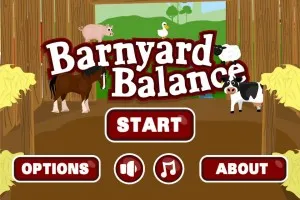
Barnyard Balance is a game where you have to keep animals off the ground by balancing them on a seesaw.
What happened: Whilst the idea seemed like fun, the screen size and controls wouldn’t quite gel together. A late move to the iPad then increased the amount of design time I needed to devote.
What I learned: Spend more time planning.
What happened: Each level required a different set of things to balance, and different things to balance them on. Whilst I could define these in something like XML, I really wanted to manipulate the levels in a more visual way to get the right balance (no pun intended) in the game.
What I learned: If your game requires levels, make sure you have some kind of level editing tool available.
What happened: In trying to create Barnyard Balance I tried to learn way too much: Lua, Toon Boom, Xcode, Corona SDK, Inkscape, how to use a Mac, Git… the list could go on. Learning each of these new things takes time in itself, without having to do it in the context of a game.
What I learned: Use more of your existing skills to develop your idea, and keep learning to a limited set of areas. Also, try to learn things that will help you in other projects.
Territory
Territory is a turn-based strategy game, in the style of Tic Tac Toe.
What happened: I turned the game into a paper version before starting development, so I could iterate through variations of the rules. Despite that, once the game was running on the device, players would end up with very similar results each time they played. Which was fun the first time around… not so fun the fourth or fifth.
What I learned: Even when the idea for a game seems good, once you play it for real it’s very hard to find a good balance for the players, especially with two or more. If you can’t get this balance right you will lose a lot of time trying to find it.
Who is it?

Who is it? is a memory game where you see illustrations of people and learn something about them (e.g. their name and favourite colour). You then need to recall that information through a series of minigames.
What happened: Part of the requirement for this game was being able to create the faces quickly and easily. If I’d pursued it, I would have lost a lot of time creating the UI widgets to build them. The UI requirements weren’t anything too complex; they just weren’t supported by the technology I chose.
What I learned: When you choose the technology for a game, make sure it can easily support the elements required to complete it. Even though I could spend time implementing everything I need, it would take me well over the timing rule.
What’s next?
By early February I hope to have my next game 100% finished. I’ve obeyed the rules, and at the time of writing I’m just under halfway through the design and development (one week in). I’ve found software that lets me easily edit the levels, the graphic design is clean and simple, and I’ve limited myself to learning only the authoring software.
So the next time I write on my blog I’ll tell you all about it. Wish me luck.